K Closest Points to Origin
LeetCode 1014 | Difficulty: Medium
MediumProblem Description
Given an array of points where points[i] = [x~i~, y~i~] represents a point on the X-Y plane and an integer k, return the k closest points to the origin (0, 0).
The distance between two points on the X-Y plane is the Euclidean distance (i.e., √(x~1~ - x~2~)^2 + (y~1~ - y~2~)^2).
You may return the answer in any order. The answer is guaranteed to be unique (except for the order that it is in).
Example 1:
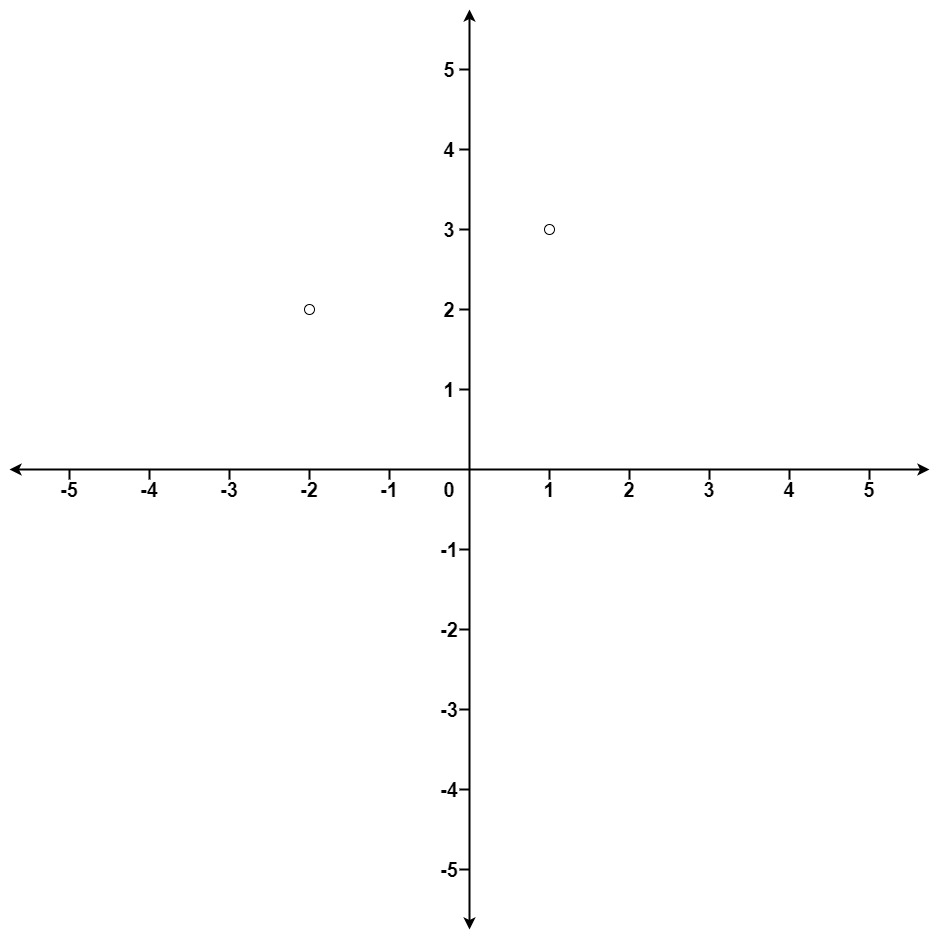
Input: points = [[1,3],[-2,2]], k = 1
Output: [[-2,2]]
Explanation:
The distance between (1, 3) and the origin is sqrt(10).
The distance between (-2, 2) and the origin is sqrt(8).
Since sqrt(8) < sqrt(10), (-2, 2) is closer to the origin.
We only want the closest k = 1 points from the origin, so the answer is just [[-2,2]].
Example 2:
Input: points = [[3,3],[5,-1],[-2,4]], k = 2
Output: [[3,3],[-2,4]]
Explanation: The answer [[-2,4],[3,3]] would also be accepted.
Constraints:
- `1 <= k <= points.length <= 10^4`

- `-10^4 <= x~i~, y~i~ <= 10^4`
Topics: Array, Math, Divide and Conquer, Geometry, Sorting, Heap (Priority Queue), Quickselect
Approach
Mathematical
Look for mathematical patterns or formulas. Consider: modular arithmetic, GCD/LCM, prime factorization, combinatorics, or geometric properties.
Problems with clear mathematical structure, counting, number properties.
Sorting
Sort the input to bring related elements together or enable binary search. Consider: does sorting preserve the answer? What property does sorting give us?
Grouping, finding closest pairs, interval problems, enabling two-pointer or binary search.
Solutions
Solution 1: C# (Best: 460 ms)
| Metric | Value |
|---|---|
| Runtime | 460 ms |
| Memory | 47.7 MB |
| Date | 2019-12-04 |
public class Solution {
    public int[][] KClosest(int[][] points, int K) {
        int len = points.Length, l = 0, r = len - 1;
    while (l <= r)
    {
        int mid = helper(points, l, r);
        if (mid == K) break;
        if (mid < K)
        {
            l = mid + 1;
        }
        else
        {
            r = mid - 1;
        }
    }
    return points.Take(K).ToArray();
    }

    private int helper(int[][] points, int lo, int hi)
{
    int[] pivot = points[hi];

    var i = lo;

    for (int j = lo; j < hi; j++)
    {
        if (compare(points[j], pivot) <= 0)
        {
            swap(points, i, j);
            i++;
        }
    }
    swap(points, i, hi);
    return i;

}

    private void swap (int[][] points, int i, int j)
{
    var temp = points[i];
    points[i] = points[j];
    points[j] = temp;
}

private int compare(int[] p1, int[] p2)
{
    return p1[0] * p1[0] + p1[1] * p1[1] - p2[0] * p2[0] - p2[1] * p2[1];
}


}
Complexity Analysis
| Approach | Time | Space |
|---|---|---|
| Sort + Process | $O(n log n)$ | $O(1) to O(n)$ |
Interview Tips
- Discuss the brute force approach first, then optimize. Explain your thought process.