Island Perimeter
LeetCode 463 | Difficulty: Easy
EasyProblem Description
You are given row x col grid representing a map where grid[i][j] = 1 represents land and grid[i][j] = 0 represents water.
Grid cells are connected horizontally/vertically (not diagonally). The grid is completely surrounded by water, and there is exactly one island (i.e., one or more connected land cells).
The island doesn't have "lakes", meaning the water inside isn't connected to the water around the island. One cell is a square with side length 1. The grid is rectangular, width and height don't exceed 100. Determine the perimeter of the island.
Example 1:
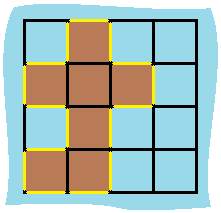
Input: grid = [[0,1,0,0],[1,1,1,0],[0,1,0,0],[1,1,0,0]]
Output: 16
Explanation: The perimeter is the 16 yellow stripes in the image above.
Example 2:
Input: grid = [[1]]
Output: 4
Example 3:
Input: grid = [[1,0]]
Output: 4
Constraints:
- `row == grid.length`

- `col == grid[i].length`

- `1 <= row, col <= 100`

- `grid[i][j]` is `0` or `1`.

- There is exactly one island in `grid`.
Topics: Array, Depth-First Search, Breadth-First Search, Matrix
Approach
BFS (Graph/Matrix)
Use a queue to explore nodes level by level. Start from source node(s), visit all neighbors before moving to the next level. BFS naturally finds shortest paths in unweighted graphs.
Shortest path in unweighted graph, level-order processing, spreading/flood fill.
Matrix
Treat the matrix as a 2D grid. Common techniques: directional arrays (dx, dy) for movement, BFS/DFS for connected regions, in-place marking for visited cells, boundary traversal for spiral patterns.
Grid traversal, island problems, path finding, rotating/transforming matrices.
Solutions
Solution 1: C# (Best: 200 ms)
| Metric | Value |
|---|---|
| Runtime | 200 ms |
| Memory | 30.3 MB |
| Date | 2020-11-01 |
public class Solution {
    public int IslandPerimeter(int[][] grid) {
        int m = grid.Length;
    int n = grid[0].Length;

    int len = 0;
    for (int i = 0; i < m; i++)
    {
        for (int j = 0; j < n; j++)
        {
            if (grid[i][j] == 1)
            {
                int left = i > 0 ? grid[i - 1][j] : 0;
                int right = i < m - 1 ? grid[i + 1][j] : 0;
                int up = j > 0 ? grid[i][j - 1] : 0;
                int down = j < n - 1 ? grid[i][j + 1] : 0;
                if (left == 1 && right == 1 && up == 1 && down == 1)
                    continue;

                len += (left == 0 ? 1 : 0) +
                (right == 0 ? 1 : 0) +
                (up == 0 ? 1 : 0) +
                (down == 0 ? 1 : 0);
            }
        }
    }

    return len;
    }
}
Complexity Analysis
| Approach | Time | Space |
|---|---|---|
| Graph BFS/DFS | $O(V + E)$ | $O(V)$ |
Interview Tips
- Start by clarifying edge cases: empty input, single element, all duplicates.