Minimum Number of Taps to Open to Water a Garden
LeetCode 1451 | Difficulty: Hard
HardProblem Description
There is a one-dimensional garden on the x-axis. The garden starts at the point 0 and ends at the point n. (i.e., the length of the garden is n).
There are n + 1 taps located at points [0, 1, ..., n] in the garden.
Given an integer n and an integer array ranges of length n + 1 where ranges[i] (0-indexed) means the i-th tap can water the area [i - ranges[i], i + ranges[i]] if it was open.
Return the minimum number of taps that should be open to water the whole garden, If the garden cannot be watered return -1.
Example 1:
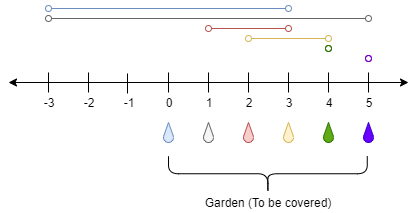
Input: n = 5, ranges = [3,4,1,1,0,0]
Output: 1
Explanation: The tap at point 0 can cover the interval [-3,3]
The tap at point 1 can cover the interval [-3,5]
The tap at point 2 can cover the interval [1,3]
The tap at point 3 can cover the interval [2,4]
The tap at point 4 can cover the interval [4,4]
The tap at point 5 can cover the interval [5,5]
Opening Only the second tap will water the whole garden [0,5]
Example 2:
Input: n = 3, ranges = [0,0,0,0]
Output: -1
Explanation: Even if you activate all the four taps you cannot water the whole garden.
Constraints:
-
1 <= n <= 10^4 -
ranges.length == n + 1 -
0 <= ranges[i] <= 100
Topics: Array, Dynamic Programming, Greedy
Approach
Dynamic Programming
Break the problem into overlapping subproblems. Define a state (what information do you need?), a recurrence (how does state[i] depend on smaller states?), and a base case. Consider both top-down (memoization) and bottom-up (tabulation) approaches.
Optimal substructure + overlapping subproblems (counting ways, min/max cost, feasibility).
Greedy
At each step, make the locally optimal choice. The challenge is proving the greedy choice leads to a global optimum. Look for: can I sort by some criterion? Does choosing the best option now ever hurt future choices?
Interval scheduling, activity selection, minimum coins (certain denominations), Huffman coding.
Solutions
Solution 1: C# (Best: 107 ms)
| Metric | Value |
|---|---|
| Runtime | 107 ms |
| Memory | 38.3 MB |
| Date | 2021-12-16 |
public class Solution {
    public int MinTaps(int n, int[] ranges) {
        int[] arr = new int[n+1];
	for (int i = 0; i < ranges.Length; i++)
	{
		int left = Math.Max(0, i-ranges[i]);
		arr[left] = Math.Max(arr[left], i+ranges[i]);
	}


	int end=0, reach =0, taps = 0;
	for (int i = 0; i < arr.Length && end < n; end = reach)
	{
		taps++;
		while(i<arr.Length && i<=end)
		{
			reach = Math.Max(reach, arr[i]);
			i++;
		}
		if(end == reach) return -1;
	}
	return taps;
    }
}
Complexity Analysis
| Approach | Time | Space |
|---|---|---|
| Dynamic Programming |
Interview Tips
- Break the problem into smaller subproblems. Communicate your approach before coding.
- Define the DP state clearly. Ask: "What is the minimum information I need to make a decision at each step?"
- Consider if you can reduce space by only keeping the last row/few values.
- LeetCode provides 3 hint(s) for this problem — try solving without them first.
💡 Hints
Hint 1: Create intervals of the area covered by each tap, sort intervals by the left end.
Hint 2: We need to cover the interval [0, n]. we can start with the first interval and out of all intervals that intersect with it we choose the one that covers the farthest point to the right.
Hint 3: What if there is a gap between intervals that is not covered ? we should stop and return -1 as there is some interval that cannot be covered.