Minimum Time to Make Rope Colorful
LeetCode 1700 | Difficulty: Medium
MediumProblem Description
Alice has n balloons arranged on a rope. You are given a 0-indexed string colors where colors[i] is the color of the i^th balloon.
Alice wants the rope to be colorful. She does not want two consecutive balloons to be of the same color, so she asks Bob for help. Bob can remove some balloons from the rope to make it colorful. You are given a 0-indexed integer array neededTime where neededTime[i] is the time (in seconds) that Bob needs to remove the i^th balloon from the rope.
Return the minimum time Bob needs to make the rope colorful.
Example 1:
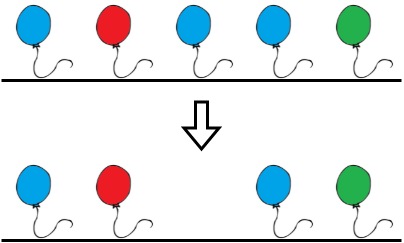
Input: colors = "abaac", neededTime = [1,2,3,4,5]
Output: 3
Explanation: In the above image, 'a' is blue, 'b' is red, and 'c' is green.
Bob can remove the blue balloon at index 2. This takes 3 seconds.
There are no longer two consecutive balloons of the same color. Total time = 3.
Example 2:
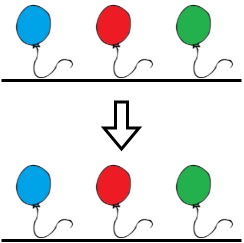
Input: colors = "abc", neededTime = [1,2,3]
Output: 0
Explanation: The rope is already colorful. Bob does not need to remove any balloons from the rope.
Example 3:
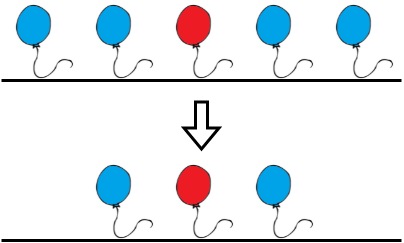
Input: colors = "aabaa", neededTime = [1,2,3,4,1]
Output: 2
Explanation: Bob will remove the balloons at indices 0 and 4. Each balloons takes 1 second to remove.
There are no longer two consecutive balloons of the same color. Total time = 1 + 1 = 2.
Constraints:
-
n == colors.length == neededTime.length -
1 <= n <= 10^5 -
1 <= neededTime[i] <= 10^4 -
colorscontains only lowercase English letters.
Topics: Array, String, Dynamic Programming, Greedy
Approach
Dynamic Programming
Break the problem into overlapping subproblems. Define a state (what information do you need?), a recurrence (how does state[i] depend on smaller states?), and a base case. Consider both top-down (memoization) and bottom-up (tabulation) approaches.
Optimal substructure + overlapping subproblems (counting ways, min/max cost, feasibility).
Greedy
At each step, make the locally optimal choice. The challenge is proving the greedy choice leads to a global optimum. Look for: can I sort by some criterion? Does choosing the best option now ever hurt future choices?
Interval scheduling, activity selection, minimum coins (certain denominations), Huffman coding.
String Processing
Consider character frequency counts, two-pointer approaches, or building strings efficiently. For pattern matching, think about KMP or rolling hash. For palindromes, expand from center or use DP.
Anagram detection, palindrome checking, string transformation, pattern matching.
Solutions
Solution 1: C# (Best: 276 ms)
| Metric | Value |
|---|---|
| Runtime | 276 ms |
| Memory | 49.5 MB |
| Date | 2021-12-02 |
public class Solution {
    public int MinCost(string s, int[] cost) {
        int n = s.Length;
	int result = 0;
	for(int i=0;i<n-1;)
	{
		var current = s[i];
		int j = i+1;
		if(current != s[j])
		{
			i++;
		}
		else
		{
			int total = cost[i], max = cost[i];
			while(j<n && s[j] == current)
			{
				total += cost[j];
				max = Math.Max(cost[j], max);
				j++;
			}

			result += (total-max);
			i=j;
		}
	}

	return result;
    }
}
Complexity Analysis
| Approach | Time | Space |
|---|---|---|
| Dynamic Programming |
Interview Tips
- Discuss the brute force approach first, then optimize. Explain your thought process.
- Define the DP state clearly. Ask: "What is the minimum information I need to make a decision at each step?"
- Consider if you can reduce space by only keeping the last row/few values.
- LeetCode provides 1 hint(s) for this problem — try solving without them first.
💡 Hints
Hint 1: Maintain the running sum and max value for repeated letters.