Bulb Switcher
LeetCode 319 | Difficulty: Medium
MediumProblem Description
There are n bulbs that are initially off. You first turn on all the bulbs, then you turn off every second bulb.
On the third round, you toggle every third bulb (turning on if it's off or turning off if it's on). For the i^th round, you toggle every i bulb. For the n^th round, you only toggle the last bulb.
Return the number of bulbs that are on after n rounds.
Example 1:
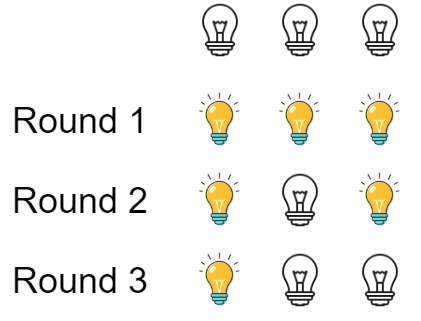
Input: n = 3
Output: 1
Explanation: At first, the three bulbs are [off, off, off].
After the first round, the three bulbs are [on, on, on].
After the second round, the three bulbs are [on, off, on].
After the third round, the three bulbs are [on, off, off].
So you should return 1 because there is only one bulb is on.
Example 2:
Input: n = 0
Output: 0
Example 3:
Input: n = 1
Output: 1
Constraints:
0 <= n <= 10^9
Topics: Math, Brainteaser
Approach
Mathematical
Look for mathematical patterns or formulas. Consider: modular arithmetic, GCD/LCM, prime factorization, combinatorics, or geometric properties.
When to use
Problems with clear mathematical structure, counting, number properties.
Solutions
Solution 1: C# (Best: 36 ms)
| Metric | Value |
|---|---|
| Runtime | 36 ms |
| Memory | 26.7 MB |
| Date | 2021-12-20 |
Solution
public class Solution {
    public int BulbSwitch(int n) {
        return (int) Math.Sqrt(n);
    }
}
Complexity Analysis
| Approach | Time | Space |
|---|---|---|
| Solution |
Interview Tips
Key Points
- Discuss the brute force approach first, then optimize. Explain your thought process.