Minimum Path Sum
LeetCode 64 | Difficulty: Medium
MediumProblem Description
Given a m x n grid filled with non-negative numbers, find a path from top left to bottom right, which minimizes the sum of all numbers along its path.
Note: You can only move either down or right at any point in time.
Example 1:
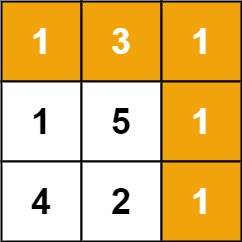
Input: grid = [[1,3,1],[1,5,1],[4,2,1]]
Output: 7
Explanation: Because the path 1 → 3 → 1 → 1 → 1 minimizes the sum.
Example 2:
Input: grid = [[1,2,3],[4,5,6]]
Output: 12
Constraints:
- `m == grid.length`

- `n == grid[i].length`

- `1 <= m, n <= 200`

- `0 <= grid[i][j] <= 200`
Topics: Array, Dynamic Programming, Matrix
Approach
Dynamic Programming
Break the problem into overlapping subproblems. Define a state (what information do you need?), a recurrence (how does state[i] depend on smaller states?), and a base case. Consider both top-down (memoization) and bottom-up (tabulation) approaches.
Optimal substructure + overlapping subproblems (counting ways, min/max cost, feasibility).
Matrix
Treat the matrix as a 2D grid. Common techniques: directional arrays (dx, dy) for movement, BFS/DFS for connected regions, in-place marking for visited cells, boundary traversal for spiral patterns.
Grid traversal, island problems, path finding, rotating/transforming matrices.
Solutions
Solution 1: C# (Best: 208 ms)
| Metric | Value |
|---|---|
| Runtime | 208 ms |
| Memory | N/A |
| Date | 2018-03-06 |
public class Solution {
    public int MinPathSum(int[,] grid) {
        int m = grid.GetLength(0);
    int n = grid.GetLength(1);

    int[,] dp  = new int[m,n];
    dp[0,0] = grid[0,0];
    for (int i = 1; i < m; i++)
    {
        dp[i,0] = dp[i-1,0]+grid[i,0];
    }
    for (int j = 1; j < n; j++)
    {
        dp[0, j] = dp[0,j - 1] + grid[0,j];
    }
    for (int i = 1; i < m; i++)
    {
        for (int j = 1; j < n; j++)
        {
            dp[i,j] = grid[i,j] + Math.Min(dp[i-1,j],dp[i,j-1]);
        }
    }
    return dp[m-1,n-1];
    }
}
Complexity Analysis
| Approach | Time | Space |
|---|---|---|
| DP (2D) | $O(n × m)$ | $O(n × m)$ |
Interview Tips
- Discuss the brute force approach first, then optimize. Explain your thought process.
- Define the DP state clearly. Ask: "What is the minimum information I need to make a decision at each step?"
- Consider if you can reduce space by only keeping the last row/few values.