Construct Binary Tree from Inorder and Postorder Traversal
LeetCode 106 | Difficulty: Medium
MediumProblem Description
Given two integer arrays inorder and postorder where inorder is the inorder traversal of a binary tree and postorder is the postorder traversal of the same tree, construct and return the binary tree.
Example 1:
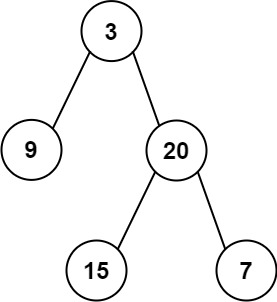
Input: inorder = [9,3,15,20,7], postorder = [9,15,7,20,3]
Output: [3,9,20,null,null,15,7]
Example 2:
Input: inorder = [-1], postorder = [-1]
Output: [-1]
Constraints:
-
1 <= inorder.length <= 3000 -
postorder.length == inorder.length -
-3000 <= inorder[i], postorder[i] <= 3000 -
inorderandpostorderconsist of unique values. -
Each value of
postorderalso appears ininorder. -
inorderis guaranteed to be the inorder traversal of the tree. -
postorderis guaranteed to be the postorder traversal of the tree.
Topics: Array, Hash Table, Divide and Conquer, Tree, Binary Tree
Approach
Hash Map
Use a hash map for O(1) average lookups. Store seen values, frequencies, or indices. The key question: what should I store as key, and what as value?
Need fast lookups, counting frequencies, finding complements/pairs.
Solutions
Solution 1: C# (Best: 124 ms)
| Metric | Value |
|---|---|
| Runtime | 124 ms |
| Memory | N/A |
| Date | 2018-05-20 |
/**
 * Definition for a binary tree node.
 * public class TreeNode {
 *     public int val;
 *     public TreeNode left;
 *     public TreeNode right;
 *     public TreeNode(int x) { val = x; }
 * }
 */
public class Solution {
    public TreeNode BuildTree(int[] inorder, int[] postorder) {
        return BuildTreeIP(inorder, 0, inorder.Length-1, postorder, 0, postorder.Length-1);
}

public TreeNode BuildTreeIP(int[] inorder,int ins, int ie, int[] postorder, int ps, int pe)
{
	if(ins>ie || ps>pe) return null;
	TreeNode root = new TreeNode(postorder[pe]);
	int index = Array.IndexOf(inorder, postorder[pe]);
	root.left = BuildTreeIP(inorder, ins, index - 1, postorder, ps, ps + index - ins - 1);
	root.right = BuildTreeIP(inorder, index+1, ie, postorder, ps + index - ins, pe-1);
	return root;
}
}
Complexity Analysis
| Approach | Time | Space |
|---|---|---|
| Hash Map |
Interview Tips
- Discuss the brute force approach first, then optimize. Explain your thought process.
- Consider: "What information do I need from each subtree?" — this defines your recursive return value.
- Hash map gives O(1) lookup — think about what to use as key vs value.