Toeplitz Matrix
LeetCode 777 | Difficulty: Easy
EasyProblem Description
Given an m x n matrix, return true if the matrix is Toeplitz. Otherwise, return false.
A matrix is Toeplitz if every diagonal from top-left to bottom-right has the same elements.
Example 1:
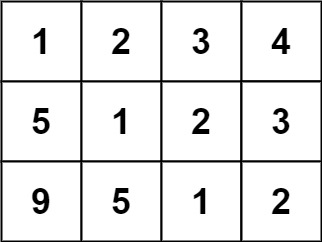
Input: matrix = [[1,2,3,4],[5,1,2,3],[9,5,1,2]]
Output: true
Explanation:
In the above grid, the diagonals are:
"[9]", "[5, 5]", "[1, 1, 1]", "[2, 2, 2]", "[3, 3]", "[4]".
In each diagonal all elements are the same, so the answer is True.
Example 2:
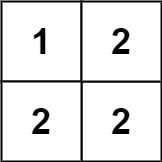
Input: matrix = [[1,2],[2,2]]
Output: false
Explanation:
The diagonal "[1, 2]" has different elements.
Constraints:
-
m == matrix.length -
n == matrix[i].length -
1 <= m, n <= 20 -
0 <= matrix[i][j] <= 99
Follow up:
-
What if the
matrixis stored on disk, and the memory is limited such that you can only load at most one row of the matrix into the memory at once? -
What if the
matrixis so large that you can only load up a partial row into the memory at once?
Topics: Array, Matrix
Approach
Matrix
Treat the matrix as a 2D grid. Common techniques: directional arrays (dx, dy) for movement, BFS/DFS for connected regions, in-place marking for visited cells, boundary traversal for spiral patterns.
Grid traversal, island problems, path finding, rotating/transforming matrices.
Solutions
Solution 1: C# (Best: 140 ms)
| Metric | Value |
|---|---|
| Runtime | 140 ms |
| Memory | N/A |
| Date | 2018-04-12 |
public class Solution {
    public bool IsToeplitzMatrix(int[,] matrix) {
        for (int i = 0; i < matrix.GetLength(0)-1; i++)
	{
		for (int j = 0; j < matrix.GetLength(1)-1; j++)
		{
			if(matrix[i,j] != matrix[i+1,j+1]) return false;
		}
	}

	return true;
    }
}
Complexity Analysis
| Approach | Time | Space |
|---|---|---|
| Solution |
Interview Tips
- Start by clarifying edge cases: empty input, single element, all duplicates.
- LeetCode provides 1 hint(s) for this problem — try solving without them first.
💡 Hints
Hint 1: Check whether each value is equal to the value of it's top-left neighbor.