Search a 2D Matrix
LeetCode 74 | Difficulty: Medium
MediumProblem Description
You are given an m x n integer matrix matrix with the following two properties:
-
Each row is sorted in non-decreasing order.
-
The first integer of each row is greater than the last integer of the previous row.
Given an integer target, return true if target is in matrix or false otherwise.
You must write a solution in O(log(m * n)) time complexity.
Example 1:

Input: matrix = [[1,3,5,7],[10,11,16,20],[23,30,34,60]], target = 3
Output: true
Example 2:
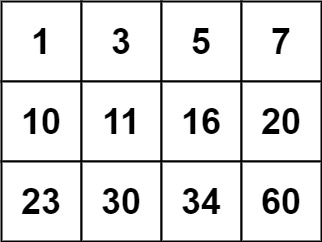
Input: matrix = [[1,3,5,7],[10,11,16,20],[23,30,34,60]], target = 13
Output: false
Constraints:
-
m == matrix.length -
n == matrix[i].length -
1 <= m, n <= 100 -
-10^4 <= matrix[i][j], target <= 10^4
Topics: Array, Binary Search, Matrix
Approach
Binary Search
Binary search reduces the search space by half at each step. The key insight is identifying the monotonic property — what condition lets you decide to go left or right?
Sorted array, or searching for a value in a monotonic function/space.
Matrix
Treat the matrix as a 2D grid. Common techniques: directional arrays (dx, dy) for movement, BFS/DFS for connected regions, in-place marking for visited cells, boundary traversal for spiral patterns.
Grid traversal, island problems, path finding, rotating/transforming matrices.
Solutions
Solution 1: C# (Best: 132 ms)
| Metric | Value |
|---|---|
| Runtime | 132 ms |
| Memory | N/A |
| Date | 2018-04-02 |
public class Solution {
    public bool SearchMatrix(int[,] matrix, int target) {
      int m = matrix.GetLength(0), n = matrix.GetLength(1);
	int i=0, j= n-1;
	while (i<m && j >=0)
	{
		if (matrix[i, j] == target)
		{
			return true;
		}
		else if (target < matrix[i, j])
		{
			j--;
		}
		else
		{
			i++;
		}
	}
	return false;
    }
}
📜 1 more C# submission(s)
Submission (2018-03-31) — 224 ms, N/A
public class Solution {
    public bool SearchMatrix(int[,] matrix, int target) {
        int i=0, j=0, m = matrix.GetLength(0), n=matrix.GetLength(1);
	while(i<m && j<n)
	{
		if(matrix[i,j]>target)
		{
			return false;
		}
		else if(matrix[i,j]==target)
		{
			return true;
		}
		else if(target<=matrix[i,n-1])
		{
			j++;
		}
		else
		{
			i++;
		}
	}
	return false;
    }
}
Complexity Analysis
| Approach | Time | Space |
|---|---|---|
| Binary Search |
Interview Tips
- Discuss the brute force approach first, then optimize. Explain your thought process.
- Precisely define what the left and right boundaries represent, and the loop invariant.