Spiral Matrix
LeetCode 54 | Difficulty: Medium
MediumProblem Description
Given an m x n matrix, return all elements of the matrix in spiral order.
Example 1:
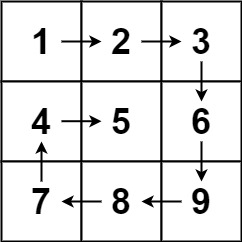
Input: matrix = [[1,2,3],[4,5,6],[7,8,9]]
Output: [1,2,3,6,9,8,7,4,5]
Example 2:

Input: matrix = [[1,2,3,4],[5,6,7,8],[9,10,11,12]]
Output: [1,2,3,4,8,12,11,10,9,5,6,7]
Constraints:
-
m == matrix.length -
n == matrix[i].length -
1 <= m, n <= 10 -
-100 <= matrix[i][j] <= 100
Topics: Array, Matrix, Simulation
Approach
Matrix
Treat the matrix as a 2D grid. Common techniques: directional arrays (dx, dy) for movement, BFS/DFS for connected regions, in-place marking for visited cells, boundary traversal for spiral patterns.
Grid traversal, island problems, path finding, rotating/transforming matrices.
Solutions
Solution 1: C# (Best: 165 ms)
| Metric | Value |
|---|---|
| Runtime | 165 ms |
| Memory | 40.8 MB |
| Date | 2022-02-10 |
public class Solution {
    public IList<int> SpiralOrder(int[][] matrix) {
       var result = new List<int>();
	int startRow = 0, endRow = matrix.GetLength(0)-1, startCol = 0, endCol = matrix[0].GetLength(0)-1;

	while(startRow <= endRow && startCol <= endCol)
	{
		for (int i = startCol; i <= endCol; i++)
		{
			result.Add(matrix[startRow][i]);
		}
		for (int i = startRow+1; i <= endRow; i++)
		{
			result.Add(matrix[i][endCol]);
		}
		for (int i = endCol-1; i >= startCol; i--)
		{
			if(startRow == endRow) break;
			result.Add(matrix[endRow][i]);
		}
		for (int i = endRow-1; i >= startRow+1; i--)
		{
			if(startCol==endCol) break;
			result.Add(matrix[i][startCol]);
		}

		startRow++;
		endRow--;
		startCol++;
		endCol--;
	}

	// Write your code here.
	return result;
    }
}
📜 1 more C# submission(s)
Submission (2017-11-06) — 542 ms, N/A
public class Solution {
    public IList<int> SpiralOrder(int[,] matrix) {
	int k = 0, l = 0, last_row = matrix.GetLength(0) - 1, last_col = matrix.GetLength(1)-1;
	if (last_col < 0 && last_row < 0) return new List<int>();

	var result = new List<int>();
	while (k <= last_row && l <= last_col)
	{
		for (int i = l; i <= last_col; i++)
		{
			result.Add(matrix[k,i]);
		}

		k++;
		for (int i = k; i <= last_row; i++)
		{
			result.Add(matrix[i,last_col]);
		}
		last_col--;

		if (k <= last_row)
		{
			for (int i = last_col; i >= l; i--)
			{
				result.Add(matrix[last_row, i]);
			}
		}
		last_row--;

		if (l <= last_col)
		{
			for (int i = last_row; i >= k; i--)
			{
				result.Add(matrix[i, l]);
			}
		}
		l++;

	}
	return result;
    }
}
Complexity Analysis
| Approach | Time | Space |
|---|---|---|
| Solution |
Interview Tips
- Discuss the brute force approach first, then optimize. Explain your thought process.
- LeetCode provides 3 hint(s) for this problem — try solving without them first.
💡 Hints
Hint 1: Well for some problems, the best way really is to come up with some algorithms for simulation. Basically, you need to simulate what the problem asks us to do.
Hint 2: We go boundary by boundary and move inwards. That is the essential operation. First row, last column, last row, first column, and then we move inwards by 1 and repeat. That's all. That is all the simulation that we need.
Hint 3: Think about when you want to switch the progress on one of the indexes. If you progress on i out of [i, j], you'll shift in the same column. Similarly, by changing values for j, you'd be shifting in the same row. Also, keep track of the end of a boundary so that you can move inwards and then keep repeating. It's always best to simulate edge cases like a single column or a single row to see if anything breaks or not.