Longest Increasing Path in a Matrix
LeetCode 329 | Difficulty: Hard
HardProblem Description
Given an m x n integers matrix, return *the length of the longest increasing path in *matrix.
From each cell, you can either move in four directions: left, right, up, or down. You may not move diagonally or move outside the boundary (i.e., wrap-around is not allowed).
Example 1:
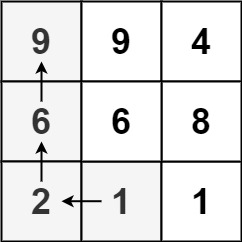
Input: matrix = [[9,9,4],[6,6,8],[2,1,1]]
Output: 4
Explanation: The longest increasing path is [1, 2, 6, 9].
Example 2:
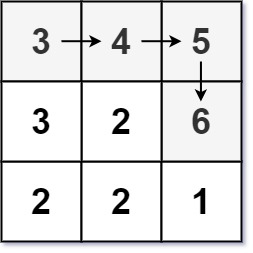
Input: matrix = [[3,4,5],[3,2,6],[2,2,1]]
Output: 4
Explanation: The longest increasing path is [3, 4, 5, 6]. Moving diagonally is not allowed.
Example 3:
Input: matrix = [[1]]
Output: 1
Constraints:
-
m == matrix.length -
n == matrix[i].length -
1 <= m, n <= 200 -
0 <= matrix[i][j] <= 2^31 - 1
Topics: Array, Dynamic Programming, Depth-First Search, Breadth-First Search, Graph Theory, Topological Sort, Memoization, Matrix
Approach
Dynamic Programming
Break the problem into overlapping subproblems. Define a state (what information do you need?), a recurrence (how does state[i] depend on smaller states?), and a base case. Consider both top-down (memoization) and bottom-up (tabulation) approaches.
Optimal substructure + overlapping subproblems (counting ways, min/max cost, feasibility).
BFS (Graph/Matrix)
Use a queue to explore nodes level by level. Start from source node(s), visit all neighbors before moving to the next level. BFS naturally finds shortest paths in unweighted graphs.
Shortest path in unweighted graph, level-order processing, spreading/flood fill.
Graph Traversal
Model the problem as a graph (nodes + edges). Choose BFS for shortest path or DFS for exploring all paths. For dependency ordering, use topological sort (Kahn's BFS or DFS with finish times).
Connectivity, shortest path, cycle detection, dependency ordering.
Matrix
Treat the matrix as a 2D grid. Common techniques: directional arrays (dx, dy) for movement, BFS/DFS for connected regions, in-place marking for visited cells, boundary traversal for spiral patterns.
Grid traversal, island problems, path finding, rotating/transforming matrices.
Solutions
Solution 1: C# (Best: 120 ms)
| Metric | Value |
|---|---|
| Runtime | 120 ms |
| Memory | 41.1 MB |
| Date | 2021-12-04 |
public class Solution {
    public int LongestIncreasingPath(int[][] matrix) {
        int m = matrix.GetLength(0);
	int n = matrix[0].GetLength(0);

	int[][] dirs = new int[][] {
	new int[] {-1, 0},
	new int[] {1, 0},
	new int[] {0, 1},
	new int[] {0, -1}
	};
	int[,] cache = new int[m,n];
	int max = 0;

	for (int i = 0; i < m; i++)
	{
		for (int j = 0; j < n; j++)
		{
			max = Math.Max(max, DfsLongestIncreasing(matrix, i, j, m, n, dirs, cache));
		}

	}

	return max;
}

private int DfsLongestIncreasing(int[][] matrix, int i, int j, int m, int n, int[][] dirs, int[,] cache)
{
	if (cache[i, j] != 0)
	{
		return cache[i, j];
	}

	int max = 1;
	foreach (var dir in dirs)
	{
		int x = i + dir[0], y = j + dir[1];
		if (x < 0 || x >= m || y < 0 || y >= n || matrix[x][y] <= matrix[i][j]) continue;
		int len = 1 + DfsLongestIncreasing(matrix, x, y, m, n, dirs, cache);
		max = Math.Max(max, len);
	}

	cache[i, j] = max;
	return max;
}

}
Complexity Analysis
| Approach | Time | Space |
|---|---|---|
| DP (2D) | ||
| Graph BFS/DFS |
Interview Tips
- Break the problem into smaller subproblems. Communicate your approach before coding.
- Define the DP state clearly. Ask: "What is the minimum information I need to make a decision at each step?"
- Consider if you can reduce space by only keeping the last row/few values.
- Ask about graph properties: directed/undirected, weighted/unweighted, cycles, connectivity.