Trapping Rain Water
LeetCode 42 | Difficulty: Hard
HardProblem Description
Given n non-negative integers representing an elevation map where the width of each bar is 1, compute how much water it can trap after raining.
Example 1:
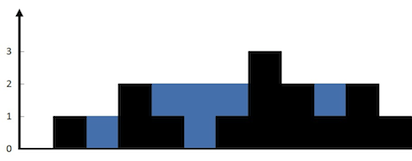
Input: height = [0,1,0,2,1,0,1,3,2,1,2,1]
Output: 6
Explanation: The above elevation map (black section) is represented by array [0,1,0,2,1,0,1,3,2,1,2,1]. In this case, 6 units of rain water (blue section) are being trapped.
Example 2:
Input: height = [4,2,0,3,2,5]
Output: 9
Constraints:
-
n == height.length -
1 <= n <= 2 * 10^4 -
0 <= height[i] <= 10^5
Topics: Array, Two Pointers, Dynamic Programming, Stack, Monotonic Stack
Approach
Two Pointers
Use two pointers to traverse the array, reducing the search space at each step. This avoids the need for nested loops, bringing complexity from O(n²) to O(n) or O(n log n) if sorting is involved.
Array is sorted or can be sorted, and you need to find pairs/triplets that satisfy a condition.
Dynamic Programming
Break the problem into overlapping subproblems. Define a state (what information do you need?), a recurrence (how does state[i] depend on smaller states?), and a base case. Consider both top-down (memoization) and bottom-up (tabulation) approaches.
Optimal substructure + overlapping subproblems (counting ways, min/max cost, feasibility).
Stack
Use a stack (LIFO) to track elements that need future processing. Process elements when a "trigger" condition is met (e.g., finding a smaller/larger element). Monotonic stack maintains elements in sorted order for next greater/smaller element problems.
Matching brackets, next greater element, evaluating expressions, backtracking history.
Solutions
Solution 1: C# (Best: 136 ms)
| Metric | Value |
|---|---|
| Runtime | 136 ms |
| Memory | 25.1 MB |
| Date | 2019-03-30 |
public class Solution {
    public int Trap(int[] height) {
        int total = 0;
	int leftMax = 0, rightMax = 0;
	int a=0, b=height.Length-1;
	while(a<=b)
	{
		leftMax = Math.Max(leftMax, height[a]);
		rightMax = Math.Max(rightMax, height[b]);
		Console.WriteLine($"{leftMax} {rightMax}");
		if(leftMax<rightMax)
		{
			total += (leftMax-height[a]);
			a++;
		}
		else
		{
			total += (rightMax-height[b]);
			b--;
		}
	}

	return total;
    }
}
Complexity Analysis
| Approach | Time | Space |
|---|---|---|
| Two Pointers | ||
| Dynamic Programming | ||
| Stack |
Interview Tips
- Break the problem into smaller subproblems. Communicate your approach before coding.
- Ask: "Can I sort the array?" — Sorting often enables two-pointer techniques.
- Define the DP state clearly. Ask: "What is the minimum information I need to make a decision at each step?"
- Consider if you can reduce space by only keeping the last row/few values.
- Think about what triggers a pop: is it finding a match, or finding a smaller/larger element?