K Radius Subarray Averages
LeetCode 2211 | Difficulty: Medium
MediumProblem Description
You are given a 0-indexed array nums of n integers, and an integer k.
The k-radius average for a subarray of nums centered at some index i with the radius k is the average of all elements in nums between the indices i - k and i + k (inclusive). If there are less than k elements before or after the index i, then the k-radius average is -1.
Build and return *an array avgs of length n where avgs[i] is the k-radius average for the subarray centered at index *i.
The average of x elements is the sum of the x elements divided by x, using integer division. The integer division truncates toward zero, which means losing its fractional part.
- For example, the average of four elements
2,3,1, and5is(2 + 3 + 1 + 5) / 4 = 11 / 4 = 2.75, which truncates to2.
Example 1:
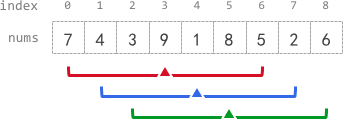
Input: nums = [7,4,3,9,1,8,5,2,6], k = 3
Output: [-1,-1,-1,5,4,4,-1,-1,-1]
Explanation:
- avg[0], avg[1], and avg[2] are -1 because there are less than k elements before each index.
- The sum of the subarray centered at index 3 with radius 3 is: 7 + 4 + 3 + 9 + 1 + 8 + 5 = 37.
  Using integer division, avg[3] = 37 / 7 = 5.
- For the subarray centered at index 4, avg[4] = (4 + 3 + 9 + 1 + 8 + 5 + 2) / 7 = 4.
- For the subarray centered at index 5, avg[5] = (3 + 9 + 1 + 8 + 5 + 2 + 6) / 7 = 4.
- avg[6], avg[7], and avg[8] are -1 because there are less than k elements after each index.
Example 2:
Input: nums = [100000], k = 0
Output: [100000]
Explanation:
- The sum of the subarray centered at index 0 with radius 0 is: 100000.
  avg[0] = 100000 / 1 = 100000.
Example 3:
Input: nums = [8], k = 100000
Output: [-1]
Explanation:
- avg[0] is -1 because there are less than k elements before and after index 0.
Constraints:
-
n == nums.length -
1 <= n <= 10^5 -
0 <= nums[i], k <= 10^5
Topics: Array, Sliding Window
Approach
Sliding Window
Maintain a window [left, right] over the array/string. Expand right to include new elements, and shrink left when the window violates constraints. Track the optimal answer as the window slides.
Finding subarrays/substrings with a property (max length, min length, exact count).
Solutions
Solution 1: C# (Best: 424 ms)
| Metric | Value |
|---|---|
| Runtime | 424 ms |
| Memory | 51.5 MB |
| Date | 2021-12-02 |
public class Solution {
    public int[] GetAverages(int[] nums, int k) {
        int n = nums.Length;
	int windowSize = 2*k+1;
	long sum = 0;
	int left=0, right=0;
	int[] result = new int[n];
	while(right<n)
	{
		sum += nums[right];
        result[right] = -1;
		if(right-left+1 >= windowSize)
		{
			result[left+k] = (int) (sum/windowSize);
            sum -= nums[left];
			left++;
		}
		right++;
	}

	return result;
    }
}
Complexity Analysis
| Approach | Time | Space |
|---|---|---|
| Sliding Window |
Interview Tips
- Discuss the brute force approach first, then optimize. Explain your thought process.
- Clarify what makes a window "valid" and what triggers expansion vs shrinking.
- LeetCode provides 3 hint(s) for this problem — try solving without them first.
💡 Hints
Hint 1: To calculate the average of a subarray, you need the sum and the K. K is already given. How could you quickly calculate the sum of a subarray?
Hint 2: Use the Prefix Sums method to calculate the subarray sums.
Hint 3: It is possible that the sum of all the elements does not fit in a 32-bit integer type. Be sure to use a 64-bit integer type for the prefix sum array.