Number of Provinces
LeetCode 547 | Difficulty: Medium
MediumProblem Description
There are n cities. Some of them are connected, while some are not. If city a is connected directly with city b, and city b is connected directly with city c, then city a is connected indirectly with city c.
A province is a group of directly or indirectly connected cities and no other cities outside of the group.
You are given an n x n matrix isConnected where isConnected[i][j] = 1 if the i^th city and the j^th city are directly connected, and isConnected[i][j] = 0 otherwise.
Return the total number of provinces.
Example 1:
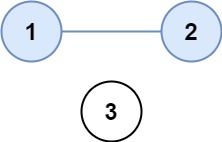
Input: isConnected = [[1,1,0],[1,1,0],[0,0,1]]
Output: 2
Example 2:
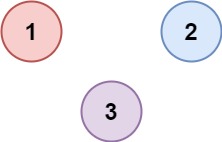
Input: isConnected = [[1,0,0],[0,1,0],[0,0,1]]
Output: 3
Constraints:
-
1 <= n <= 200 -
n == isConnected.length -
n == isConnected[i].length -
isConnected[i][j]is1or0. -
isConnected[i][i] == 1 -
isConnected[i][j] == isConnected[j][i]
Topics: Depth-First Search, Breadth-First Search, Union-Find, Graph Theory
Approach
BFS (Graph/Matrix)
Use a queue to explore nodes level by level. Start from source node(s), visit all neighbors before moving to the next level. BFS naturally finds shortest paths in unweighted graphs.
Shortest path in unweighted graph, level-order processing, spreading/flood fill.
Graph Traversal
Model the problem as a graph (nodes + edges). Choose BFS for shortest path or DFS for exploring all paths. For dependency ordering, use topological sort (Kahn's BFS or DFS with finish times).
Connectivity, shortest path, cycle detection, dependency ordering.
Union-Find
Maintain disjoint sets with two operations: find (which set does element belong to?) and union (merge two sets). Use path compression and union by rank for near O(1) amortized operations.
Connected components, cycle detection in undirected graphs, grouping elements.
Solutions
Solution 1: C# (Best: 112 ms)
| Metric | Value |
|---|---|
| Runtime | 112 ms |
| Memory | 28.6 MB |
| Date | 2020-01-29 |
public class Solution {
    public int FindCircleNum(int[][] M) {
       bool[] visited = new bool[M.Length];
	int count = 0;
	for (int i = 0; i < M.Length; i++)
	{
		if(!visited[i])
		{
			count++;
			visited[i] = true;
			dfs(M, visited, i);
		}
	}
	return count;
}

public void dfs(int[][] M, bool[] visited, int person)
{
	for (int other = 0; other < M.Length; other++)
	{
		if(!visited[other] && M[person][other] == 1)
		{
			visited[other] = true;
			dfs(M, visited, other);
		}
	}
}

}
Complexity Analysis
| Approach | Time | Space |
|---|---|---|
| Graph BFS/DFS | ||
| Union-Find |
Interview Tips
- Discuss the brute force approach first, then optimize. Explain your thought process.
- Ask about graph properties: directed/undirected, weighted/unweighted, cycles, connectivity.